
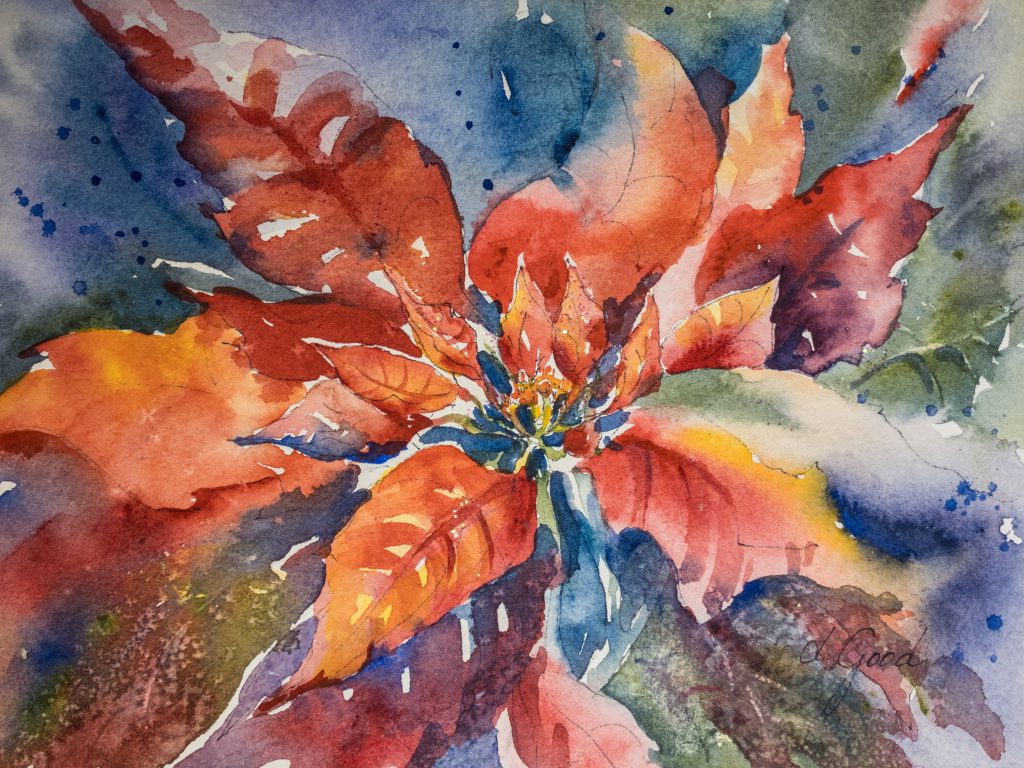
Winter Poinsettia
Operetta
Bright red and orange poinsettia leaves spread across loose blue and green washes.
The original watercolor is held in the artist collection.
About the Painting
The plant fills the sheet from edge to edge, seen from above, with its colored leaves radiating from a small cluster of gold and green at the center. Donna paints each leaf as a broad shape of red, orange and crimson, then adds fine dark veins that follow the leaf from its tip to its base.
The background is loose and lively: blue, violet, green and gold run together, and small spatters of deep blue are scattered across the upper corners. Thin slivers of white paper show between and within the leaves, and they read as light glancing off the surface of the plant. Toward the lower edge, the leaves deepen into violet and green, and a textured wash of granulated color suggests the leaves in shadow.
Fine drawn lines trace the edges and veins of several leaves, and they show through the transparent color. The center of the plant holds the smallest and brightest shapes in the painting, a cluster of gold, green and blue. The leaves overlap in layers, and where one crosses another, Donna deepens the red to crimson, so the plant gains depth with every fold.
The poinsettia is native to Mexico and Guatemala, and Joel R. Poinsett brought it to the United States in the early 1800s. A Philadelphia nurseryman, Robert Buist, named the plant after him. The red shapes that read as petals are bracts, modified leaves that gather around small yellow flowers at the center, just as Donna paints them.
The title, Winter Poinsettia Operetta, gives the painting a musical name, and the leaves do seem to sing out in every direction. It hangs in The Winter Room with three other winter paintings, and its warm reds bring color to that red room. Donna signs her name in the lower right corner, in a pocket of dark violet.


Keep Looking
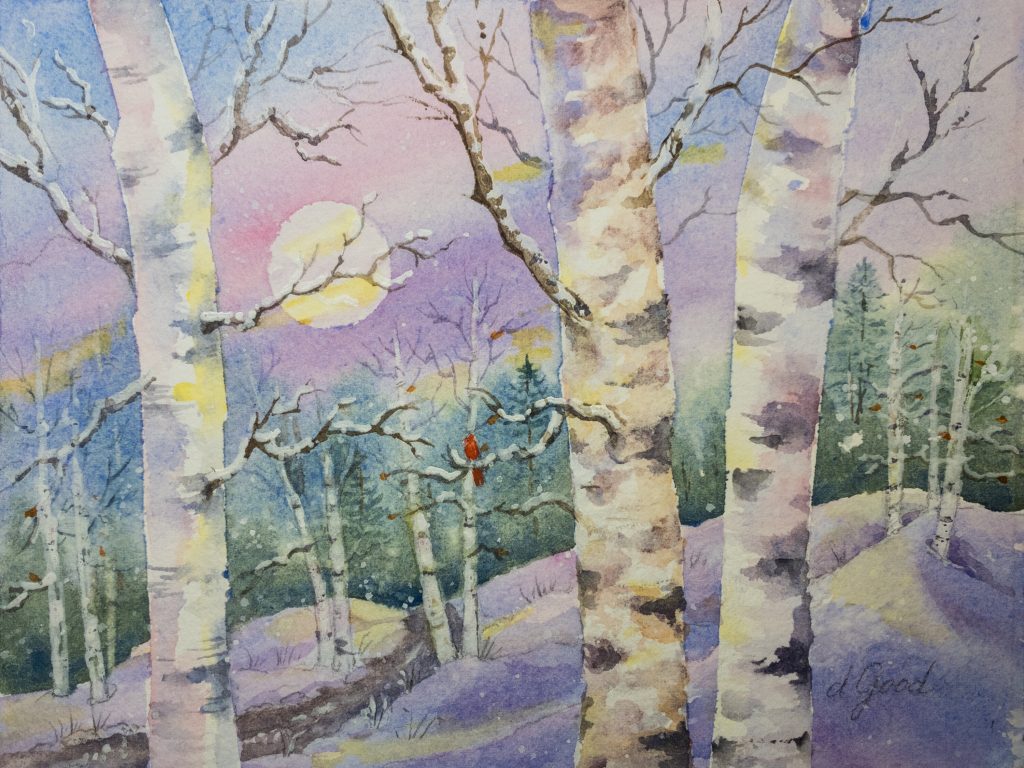
Winter Moon Over Red Bird in Aspen Forest
M. Donna Good Watercolor
Winter Moon in Pine Valley
M. Donna Good Watercolor